Iowa Big Tree Report (July - December 2025)
IOWA BIG TREE REPORT FOR JULY THROUGH DECEMBER 2025
SUBMITTED BY MARK ROUW, IOWA BIG TREE FIELD REPRESENTATIVE
July 1st
Grady Stein and I headed for Laurel Hill Cemetery in Des Moines to measure a sugar maple that doesn’t stand too far from a big sycamore that is included on the spreadsheet. Wouldn’t you know it, there were cemetery workers mowing in close proximity to the tree. I thought this might interfere with our measuring, but to my surprise they asked us if they were in our way. Apparently our reputation preceded us! The tree turned out to be of respectable size with the following dimensions:
Circ. 12.21’, height 69.75’, spread 86.665’, index 237.916, rank # 6
We considered measuring another sugar maple in Laurel Hill, but after scrutinizing the trunk we decided it was a fusion of two trunks, so we left, and headed to the Iowa State Fairgrounds just a few blocks away. At one time there were three trees from the state fairgrounds in the big tree registry. The big catalpa has been gone for years, but a white fir and sycamore remain. The sycamore is very special to me, not only because it is a very beautiful tree, but also for sentimental reasons. It was under the crown of this tree where I proposed marriage to my lovely Rita! Here are the updated dimensions of the sycamore:
Circ. 15.25’, height 95.5’, spread 99’, index 303.25, rank # 27
The white fir at the fairgrounds is one of the smallest on the spreadsheet, but it is notable for two desirable traits. First, it maintains one central leader for most of its’ height which is rare for this species, and it surpasses 80’ in height. Here are the current dimensions of the white fir:
Circ. 7.83’, height 82.75’, spread 38.5’, index 186.375, rank # 14
July 2nd
I have walked nearly every street in Des Moines, and during that time I have found three overcup oaks, all of which were found growing on the parking right of way. Interestingly, the largest of the three, stood only about one block from where I grew up just south of Grandview University! Some years ago, a new public sidewalk was put in next to this tree and some large roots were cut in the process. Not surprisingly, the tree died. We may have lost a champion tree, but at least we gained a new and improved sidewalk!
The current champion overcup oak stands on the north side of Guthrie Ave. on the east side of Des Moines. Here are the updated dimensions of the champion overcup oak:
Circ. 9.17’, height 54.75’, spread 62.5’, index 180.375, rank # 1
July 17th
Several years ago, I noticed a good sized basswood in Mason City. It wasn’t exceptionally large, but I thought it was worthy of documenting. After receiving permission to measure the tree, Grady Stein and I made the trip to Mason City. These are the dimensions we found for the basswood:
Circ. 12.42’, height 80.42’, spread 67.125’, index 246.08, rank # 6
After leaving the site of the above basswood, we spotted another good sized basswood. The owner was home and we received permission to measure the tree. Here is what we found:
Circ. 13.08’ (meas. below 4 ½’), height 79.42’, spread 68.5’, index 253.546, rank # 5
This one was even bigger than the one I went to Mason City to measure! I would like to point out, however, although this one is bigger on points, it has a low limb which caused the trunk circ. to be larger than it would have been had the trunk been typical. We found a large caterpillar on the tree which appears to have been a larval elm sphinx moth. I have seen adults, but never a caterpillar of that species.
The next stop was to check out a reported large bur oak in Clear Lake. The nominator was very nice, and interesting. He was at the Surf Ballroom on the day the music died! The bur oak was quite large for northern Iowa, but it would be impossible to measure the trunk. It grew against the inside corner of a cottage. It was so close to the walls, there was no room to get a tape measure around the trunk! This is a case where the diameter would have to be determined in order to calculate the circumference. I would estimate the circumference would have been a little over 14’.
Just a stone’s throw from the Surf Ballroom, I noticed a tree that looked out of place. Later Grady and I investigated it further. It turned out to be a good sized white ash, at least by today’s standards. The owner was home, and she was very cooperative. The tree had been treated to help protect it from EAB, but it did have a rather large limb that was dead. According to the owner the limb was dead prior to EAB reaching the area. We determined the ash to have the following dimensions:
Circ. 11.92’, height 61.83’, spread 71,75’, index 224.486, rank # 1
The largest white ash from Union, had a circ. of 17’2”, but died a few years ago. Are there other big white ashes, or large ashes of any species out there that have been treated? If you know of any large ash trees, please let me know.
Now it was time to head home, but I did have one more stop planned along the route towards home. Previously, I had noticed some large arborvitae in the cemetery in Belmont. When we arrived at the cemetery we only had time to measure one of the many arborvitaes. There were three large ones, but which one should we measure? One of the arborvitae was noticeably bigger, but we concluded it was a fusion of two trunks. Grady suggested one of the two biggest ones for measurement, so now we could concentrate on that tree. There was a lot of bird activity in and adjacent to the cemetery. Grady and I are both into birds, so that was an added bonus. Grady concentrated on the birds and I measured the arborvitae. The arborvitae had these dimensions:
Circ. 8.67’, height 56.83’, spread 36.75’, index 170.018, rank # 15
July 24th
Matt Markworth, my big tree hunting friend from Ohio was back in Iowa to pick up his Haiku exhibit in Camanche, and today we met in Burlington. If my memory serves me right, we met at the former home of Aldo Leopold. We also met Steve Brower, who is head of the Aldo Leopold Landscape Alliance. Steve showed us a good sized white oak which stood very close to a home on the Mississippi River bluff in Burlington. We didn’t take time to measure the tree other than getting a quick circumference measurement of just over 13’. Steve took us to a beautiful bur oak just outside of town, but it wasn’t quite large enough to justify measuring. Patrick Moore, the Burlington City Arborist joined us on this part of the outing, but he was called away after we checked this bur oak.
Our next stop was to visit the number three white oak on the south side of Burlington. It stands only one block away from the champion black oak! We only updated the circumference. Here are the dimensions of the white oak:
Circ. 15’.375’, height 76’, spread 121.67’, index 290.875, rank # 3
The champion tulip tree grows in the same neighborhood and we stopped by to update the circumference. Here are the most current dimensions:
Circ. 16.83’, height 110.67’, spread 86.25’, index 334.233, rank # 1
It was getting late in the day so we headed to the Aldo Leopold House. Previously, I had made arrangements with Steve Brower to spend the night in this wonderful old mansion. The mansion is impressive from the outside, but you don’t fully appreciate its size until you get inside!
July 25th
We stopped to visit a very large and well-formed black oak that stands on the parking right of way in southern Burlington. Of the following dimensions only the circumference was updated:
Circ. 15.21’, height 75’, spread 110’, index 285, rank # 5
Our next stop was Dankwardt Park which has several notable trees. We updated the circumference of the largest swamp white oak in the park:
Circ. 14.79’, height 90.08’, spread 86.5’, index 289.205, rank # 2
One of the largest European larches in Iowa lives in Dankwardt Park, and we updated the circumference:
Circ. 13.96’, height 78’, spread 58.5’, index 260.125, rank # 3
The previous day after Matt and I had split up, I identified a large shingle oak in the backyard of a property in south Burlington, and I received permission to measure the tree. This tree was not new to me, but every other time I had seen the tree it was bare, and I had mistaken it for a pin oak. I always thought the form was atypical for a pin oak, but the bark and twigs seemed to fit. Even though it was leafed out this time, I almost missed the identification again. I thought the leaves didn’t look like a pin oak but my vision is so poor. I couldn’t quite tell. It wasn’t until I walked closer to the tree that I was able to positively identify it as a shingle oak. Here are the dimensions of this exemplary shingle oak:
Circ. 12.92’, height 72.17’, spread 102.665’, index 252.836, rank # 2
This is not the first time I have been fooled by a shingle oak. I noticed the champion shingle oak in Montrose years before it was nominated, but the tree was bare, and I thought it was a black oak!
Back in the mid-1980s, I was visiting Burlington and my Volkswagen Dasher broke down on Hwy 61 at the south edge of Burlington. I was actually not far from a Volkswagen dealership, but I had learned from previous breakdowns that repairs at the dealership were too expensive for my limited finances. This was also before cell phones. As luck would have it, across the highway from where I broke down was a house. Interestingly, there was a large black or sugar maple in the front yard of the property. I knocked and a young lady came to the door. I explained my situation, and she told me if it were up to her she would let me use the phone, but her mother would kill her if she let a stranger in the house! I must have walked to the Volkswagen dealership to use their phone. I called my dad, and the next day he came down and towed me back to Des Moines. This was another night spent trying to sleep in my car!
I never forgot that big maple, and today Matt and I stopped to check it out. This time there was no young lady coming to the door. A man answered the door and he said we could measure the tree but he would not allow the nomination! The tree turned out to be a black maple and it had a circumference of 14.625’. The trunk was a little questionable, but if it were given the benefit of the doubt, it would have qualified as a new state champion!
The last stop of the day, and of the trip was at Perkins Park where I showed Matt the state champion hackberry. We updated the circumference, and here are the dimensions of the hackberry:
Circ.16.08’, height 86.08’, spread 89.25’, index 299.393, rank # 1
August 5th
I met Grady Stein at Glendale Cemetery where several significant trees reside. First we updated the trunk circumference of a Douglas-fir in the state big tree registry. Here are the dimensions of the Douglas-fir:
Circ. 8.17’, height 85.08’, spread 39.25’, index 192.893, rank # 9
Our next tree was an English oak that had never been measured. We found the oak to have these dimensions:
Circ. 12.83’, height 60.5’, spread 85.58’, index 233.175, rank # 2
August 6th
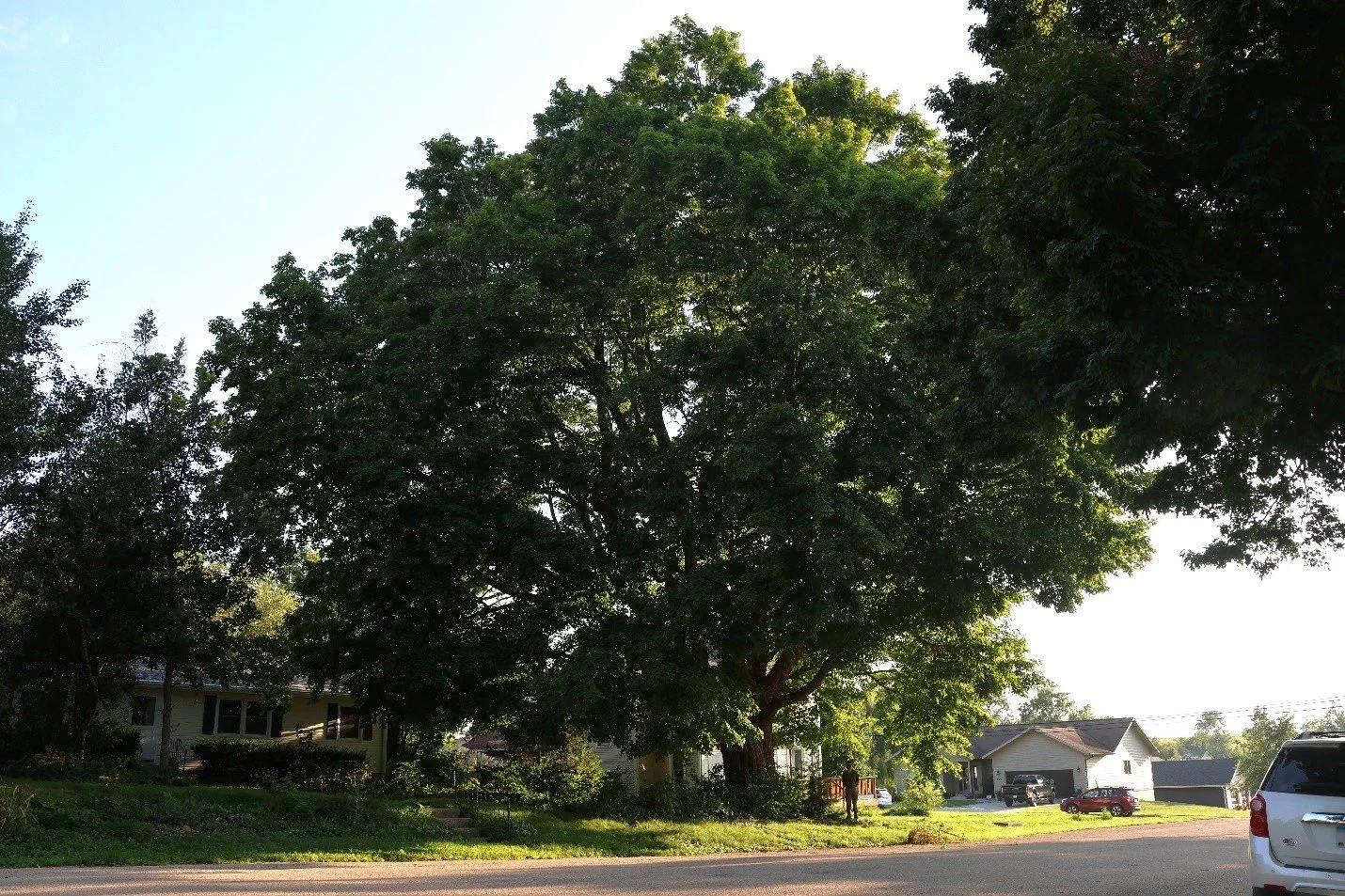
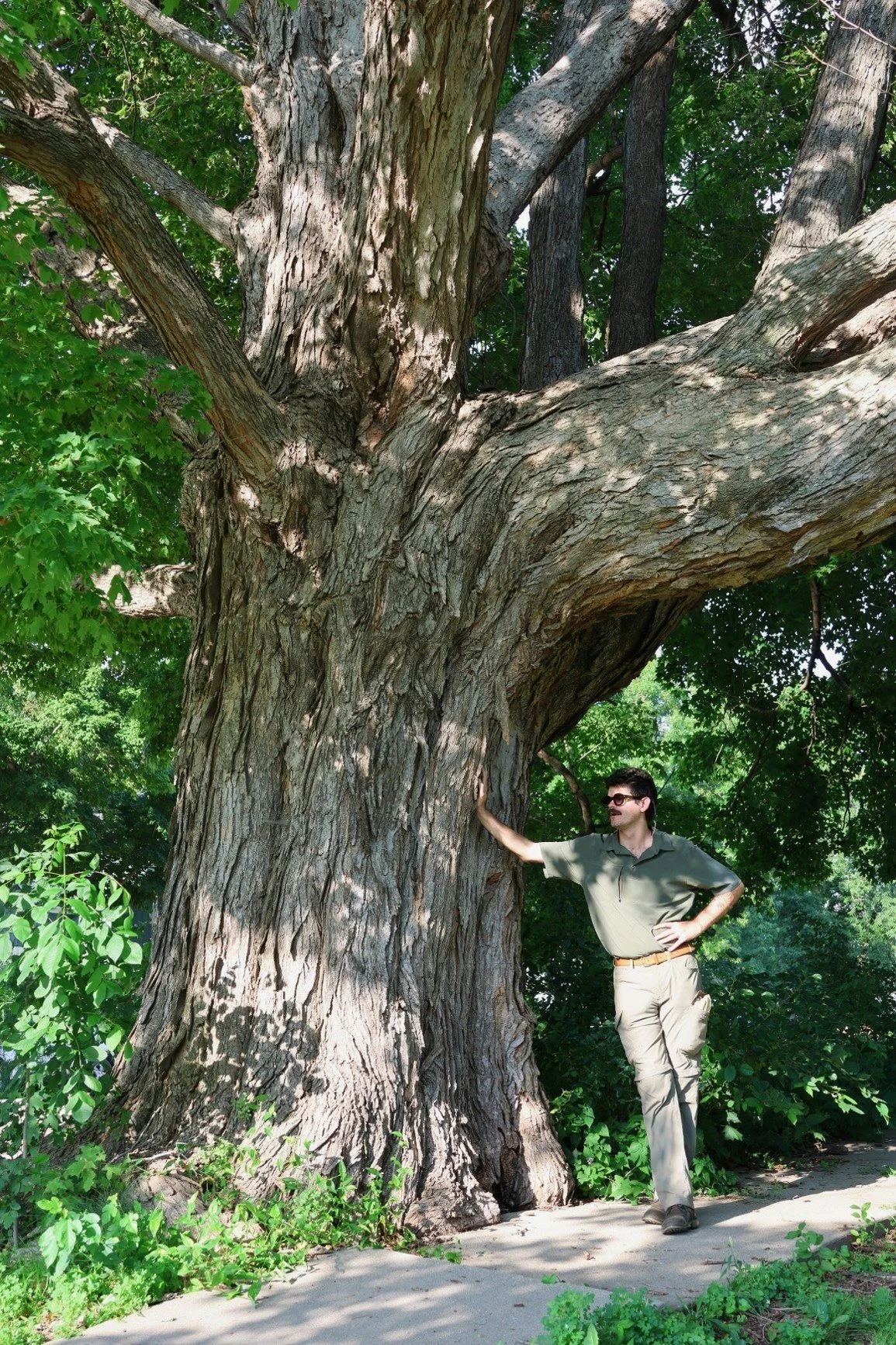
Today, Grady and I went to Gladbrook to measure a sugar maple and a Douglas-fir. The sugar maple has been mentioned in a previous report. It stands on the parking right of way, and a section of the base was cut to make room for a beautiful new sidewalk! Despite the injury which has done considerable damage to the trunk, the tree is still growing at a good rate. We found the maple to have these dimensions:
Circ. 16.5’, height 77.58’, spread 96.58’, index 299.725, rank # 1
The Douglas-fir located at the s. edge of the city park in Gladbrook is a tree I have been monitoring since at least 1992. Despite losing 6’ of height due to the 2020 derecho this tree has attained the status of champion after the loss of the number one Douglas-fir in Dubuque. Here are the dimensions:
Circ. 9.75’, height 77’, spread 43’, index 204.75, rank # 1
August 8th
Grady and I took the short trip south from Des Moines to Indianola to check out several trees. Our first stop was to the city library to get updated measurements of the champion nannyberry. We found the tree to have these dimensions:
Circ. 3.625’ @ 2’, height 24.5’, spread 30’, index 75.5, rank # 1
Next we headed to the cemetery at the south edge of Indianola. The co-champion red cedar that lives here is the only remaining champion from the very first listing of Iowa’s Biggest trees! Since the first big tree list another slightly larger red cedar near Jefferson was nominated. The co-champion Cedar near Jefferson is currently two points larger than the Indianola tree. Here are the dimensions of the Indianola red cedar:
Circ. 10.96’, height 61.92’, spread 40.835’, index 203.629, rank # 2
Now we were going to measure the largest white pine in the cemetery. Interestingly, back in 1978 when I first measured trees in the Indianola cemetery, there were two white pines larger than this one. One of these was the state champion for a number of years. The tree was cut sometime after March of 2024 when the dimensions were last updated. The circumference had reached a remarkable 16.33’! The white pine that at one time was the second largest in the cemetery, suffered considerable storm damage years ago, and now it has a rank of 46th largest in Iowa. Meanwhile the number three tree kept growing while waiting in the wings. Now that pine is the largest in the cemetery and one of the largest in Iowa. Here are the latest dimensions of the pine:
Circ. 14.125’, height 86.08’, spread 72.085’, index 273.601, rank # 13
August 14th
Today Grady and I went to Grinnell to check on some of the trees on the Grinnell College Campus. There used to be three large sycamores in a row on the beautiful campus. One of those three trees was cut down, apparently because it stood too close to a new concrete parking lot. Then the 2020 derecho broke the tops out of the two remaining sycamores. One of these two sycamores was one of my favorite trees of any species, and it was very disappointing to see the damage caused by the storm. The tree did stand 108’ tall which is exceptional for an open grown sycamore in these parts. Here are the updated dimensions of the largest sycamore on the Grinnell College Campus:
Circ. 15.83’, height 98.92’, spread 74.335’, index 307.504, rank # 26
South of the sycamores stands a cottonwood that isn’t especially tall but it has a good circumference and spread. Of the following dimensions only the circumference was updated:
Circ. 23.29’, height 82.22’, spread 105.25’, index 378.53, rank # 23
The largest yellow buckeye makes its home on the east edge of the Grinnell College Campus. Here are the updated dimensions:
Circ.10.92’, height 83.75’, spread 48.25’, index 226.13, rank # 1
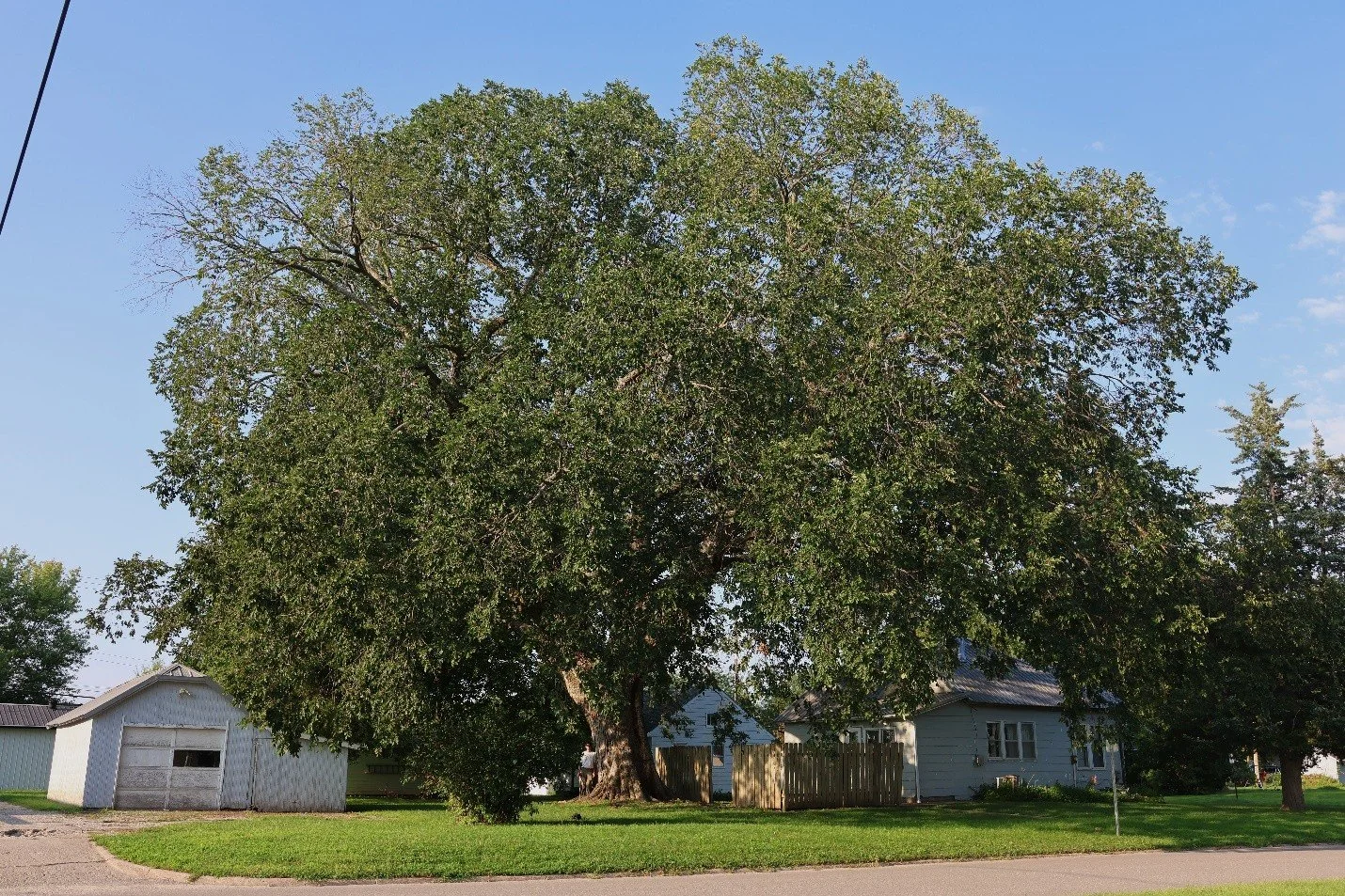
The next stop would be in Sigourney to visit the champion American elm. I was hopeful the tree would be looking good, but I was disappointed. The foliage in the crown looked sparse and there was what appeared to be a recently dead branch. Hopefully the tree is not in serious trouble. The following measurements were taken on April 27th, 2025:
Circ. 18.04’, height 70.92’, spread 126.915’, index 318.689, rank # 1
Our next stop was the site of the champion cucumbertree west of North English. We didn’t end up taking the shortest route, and we went through What Cheer, where we noticed a respectable pin oak. Although it was large it wouldn’t rank among the biggest. After photographing the cucumbertree it was time to head home.
August 21st
In my attempt to get the best big tree photographs possible, I decided to visit the champion cucumbertree near North English once again. On the way, I stopped at a cemetery in Jasper County in an attempt to improve on my previous photographs a co-champion ponderosa pine. It was dry and there was a breeze from the east which turned out to be a bad combination. The cemetery with the ponderosa pine sits west of a gravel road, and every time a car passed a cloud of dust soon followed. I found myself trying to get photos taken between cars passing by, but it was still pretty hazy. So much for upgrading photos of this tree!
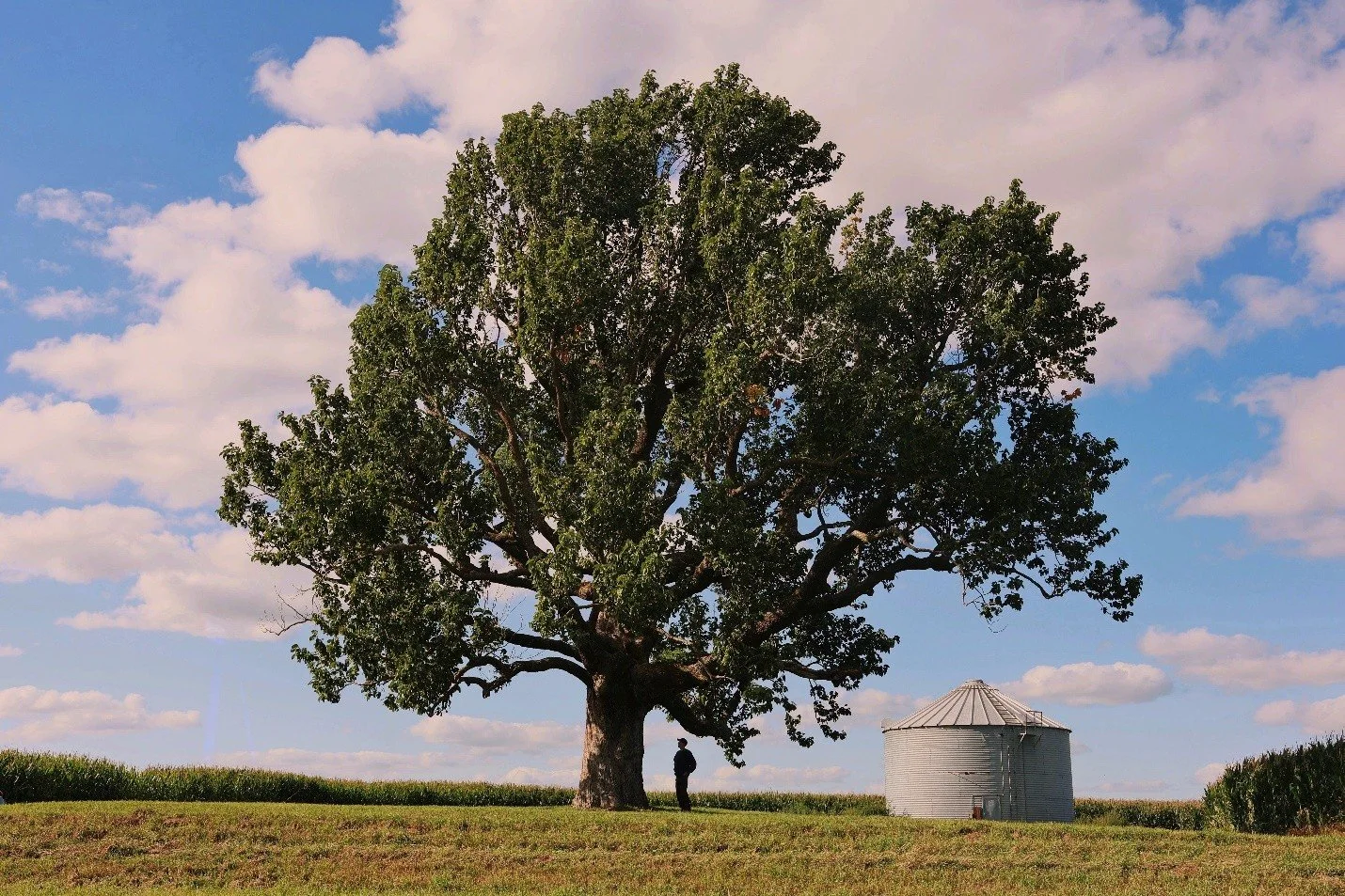
The reason I chose to photograph the champion cucumbertree on this day was because of the many white fluffy clouds, which in my opinion add interest to landscape and tree photos. By the time I reached the cucumbertree, I was hurrying to get my camera set up because the clouds would soon be gone. I was only able to get a few photos before the sky was clear. I was able to get a few good photos, but not of the quality I was hoping to get!
August 23rd
I made another trip to photograph the champion cucumbertree!
August 24th
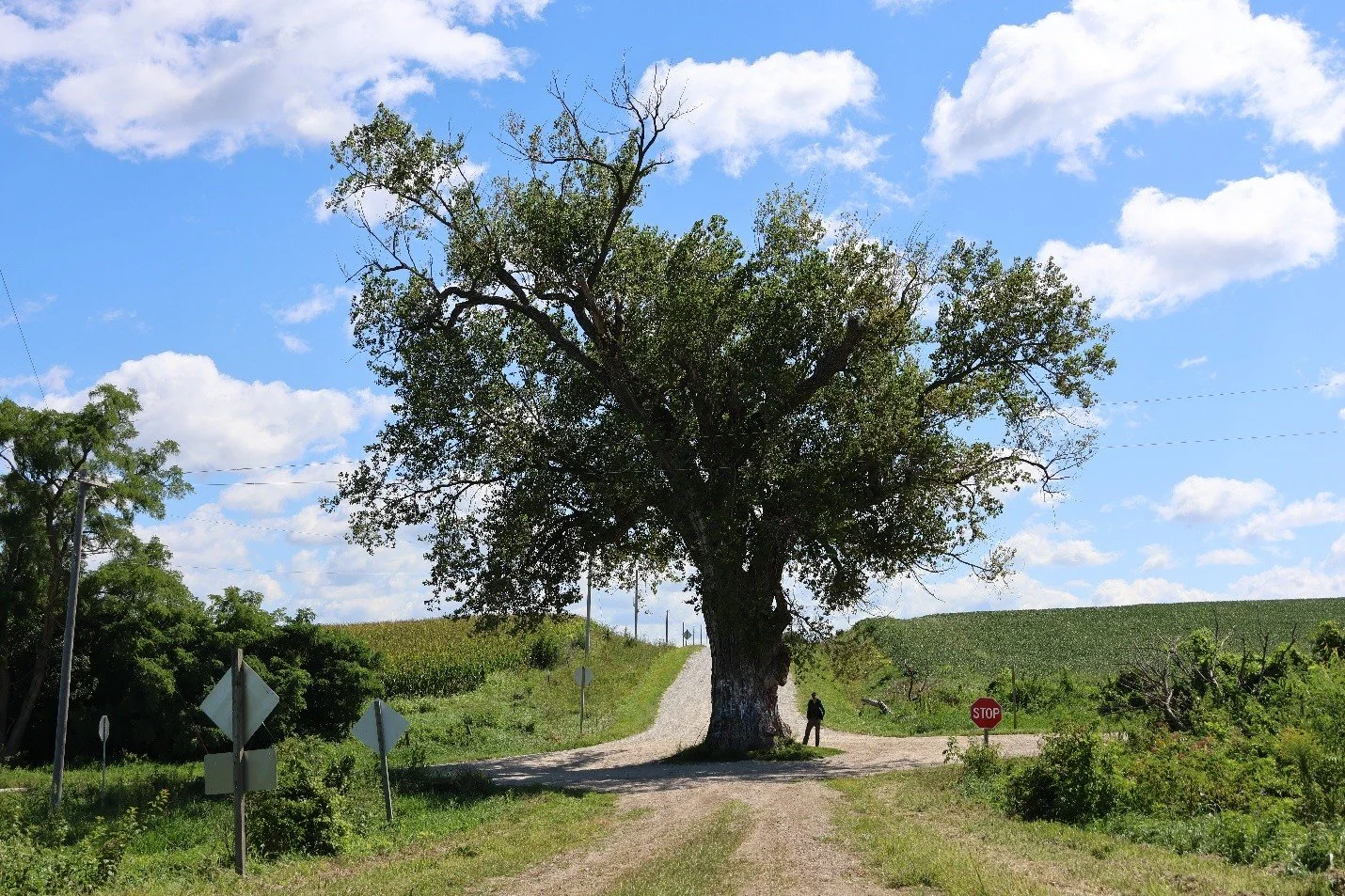
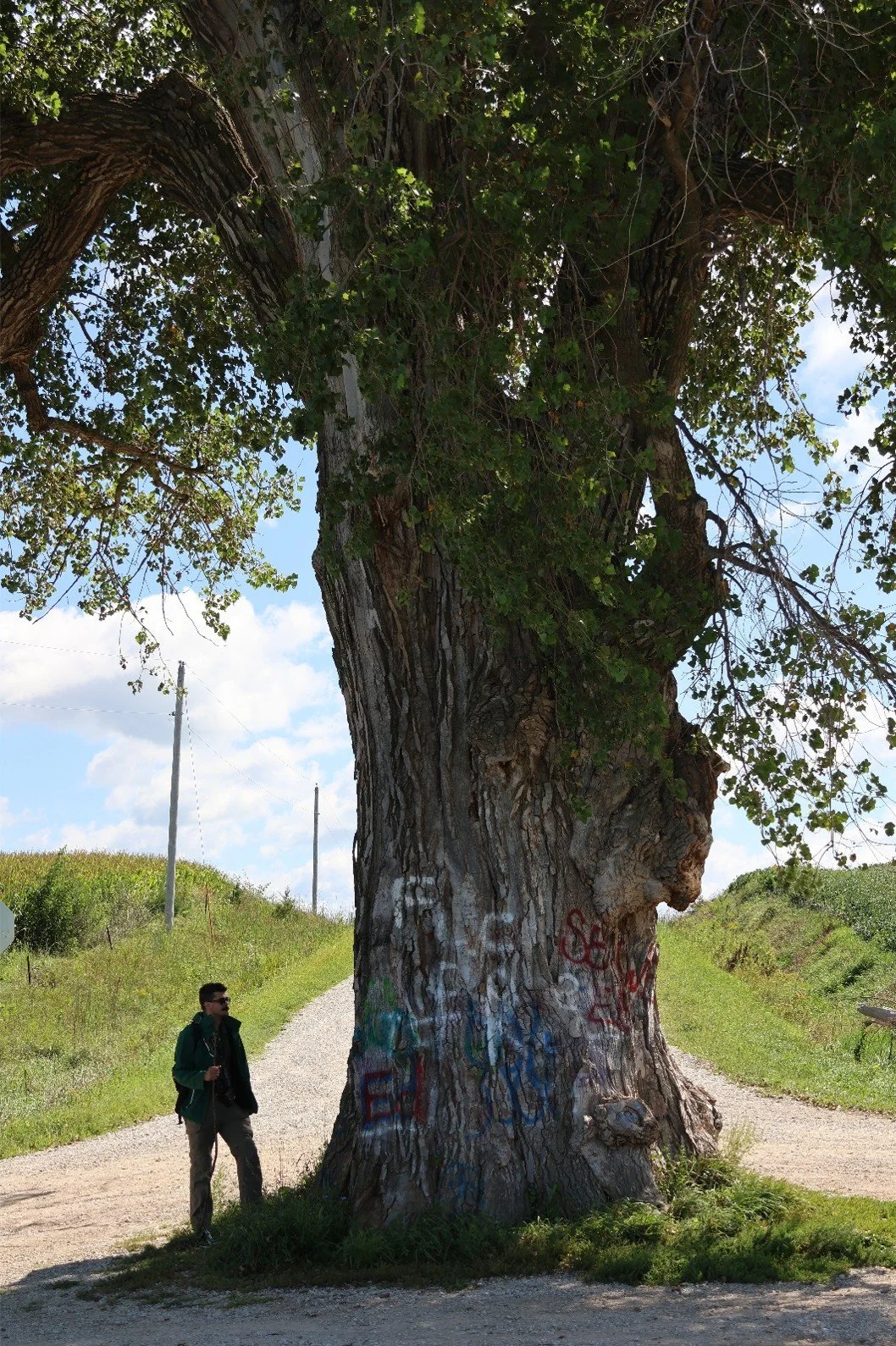
Today, Grady Stein and I headed west to see the cottonwood in the middle of the road near Brayton in Audubon County. I had heard about this tree for many years, but I had never gone to see the tree. It is a big, impressive cottonwood, however it has lost several large limbs, which has reduced the height and spread, its trunk is a canvas for the local graffiti, artists. Not only does the tree stand in the middle of the road, it stands in the middle of an intersection. We determined the cottonwood to have these dimensions:
Circ. 21.71’, height 67.17’, spread 72.835’, index 345.875, rank 34
Before heading to our next destination, we explored some of the area not far from the cottonwood, and we passed by the largest privately reconstructed prairie I had ever seen! We worked our way over to near Exira to see the plow in the oak, and you can still see a bit of the plow on either side of the tree. I’m sorry to report the plow in the oak, which is a bur oak, does not look good. It has a lot of dead limbs and it appears to be dying. West of the park where the plow in the oak stands is the largest cattle feedlot I have ever seen. I was as disappointed in this sight as much as I was impressed with the restored prairie I had seen a short time earlier!
The next stop was the cemetery in Atlantic. I have mentioned the two big ponderosa pines here in a previous report. The two pines are almost identical in total points, but the southern tree is taller with a smaller trunk circumference while the northern one it is not as tall, but it as a larger circumference. Only the circumference was updated for these pine:
ponderosa pine, southern tree - circ. 8.79’, height 70.67’, spread 50’, index 186.67, rank # 5
ponderosa pine, northern tree - circ. 9.67’, height 62.33’, spread 45.75’. index 189.608, rank # 3
Before heading home, we checked out the other trees in the cemetery. We noticed a large black maple, but it would have to wait until another time.
October 4th
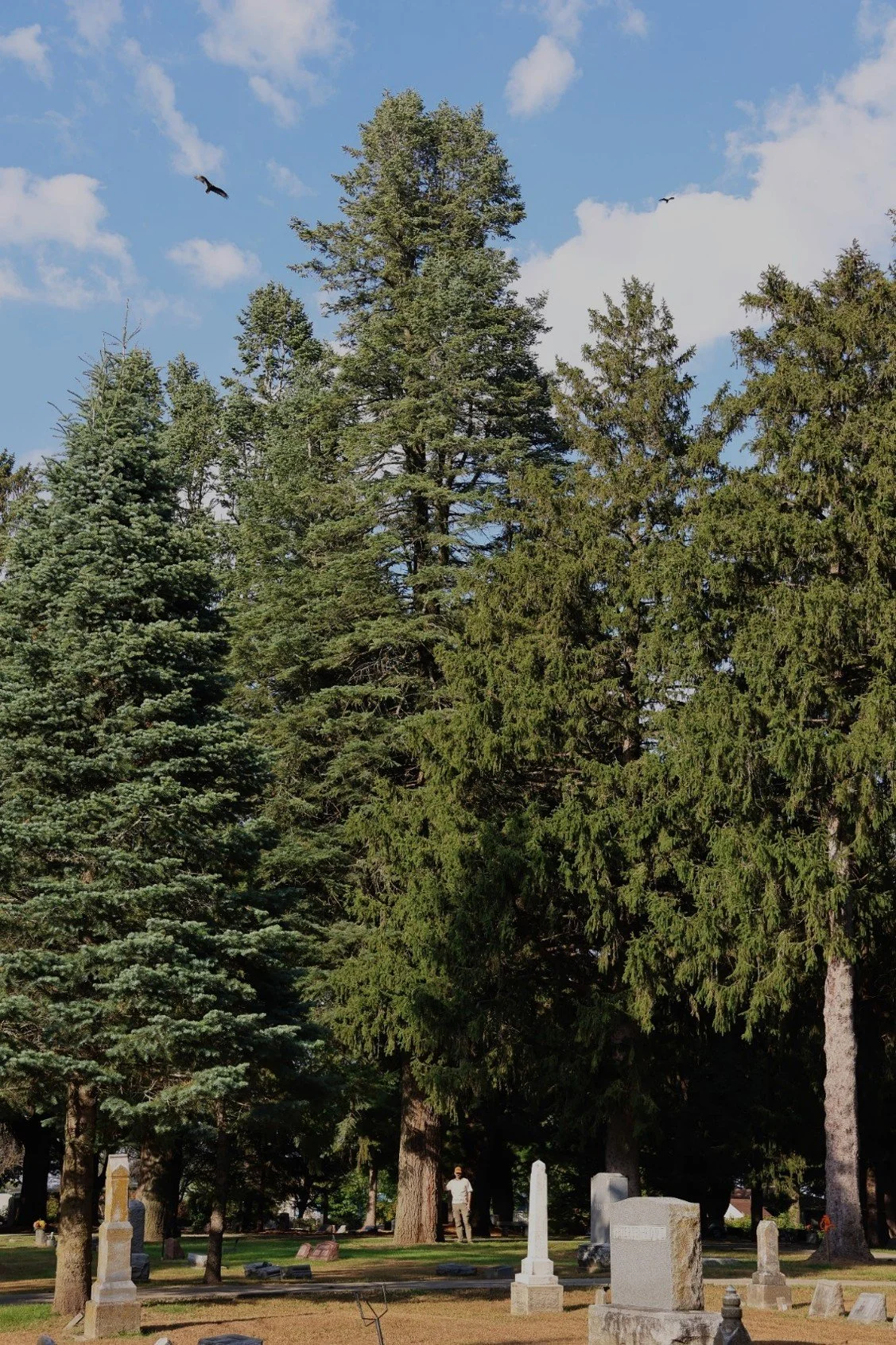
Grady and I went to the Hampton cemetery which is one of my favorite places. The main goal was to get quality photographs of the second largest white fir in Iowa. The three largest white firs live in this cemetery, but in my opinion the number two white fir is the most impressive. Apparently turkey vultures roost in the cemetery, and because of the windy conditions they were roosting until our presence made them too uncomfortable, and they took flight. I was able to get several photos of the fir with turkey vultures in view. Later we saw turkey vultures in the distance on the ground. We surmised they were on the ground because the wind would make flying difficult, and we were too close to their roost. The white fir had the following dimensions:
Circ. 11.125’, height 96.25’, spread 36.75’, index 237.563, rank # 2
On the way home we stopped at the cemetery in Ackley where we found a large hemlock. It was too late for good photos, but there was enough time to get the tree measured. The trunk circumference was quite sizable which contributed to the high rank. Here are the dimensions of the hemlock:
Circ. 11.47’, height 69.75’, spread 63.04’, index 222.56, rank # 2
October 24th
Laurie Dams and I went to Iowa City for the rescheduled Tree Measuring Workshop at the University of Iowa. It was hosted by Scott Carlson with the Iowa Arborist Association. Andy Dahl, and Grady Stein, who I really hoped would be there, were unable to attend, which was disappointing, but I think it was worthwhile for those who did attend. I presented my “Iowa’s Largest and Tallest Trees” PowerPoint program in the Old Capitol, and then we practiced a couple of tree height measuring techniques on a few nearby trees on the campus. We concentrated on the measuring process rather than on determining precise measurements. One of the practice trees was the champion black walnut in front of McBride Hall. The circumference measured 17.96’ which is a remarkable girth for an Iowa walnut!
Oct. 26th
Grady and I went to Earlham, with the goal of measuring what appeared to be a very large hackberry. The trunk was round which indicated a single trunk, and the bole was devoid of any limbs for at least twenty feet before it divided into two large limbs. Most people would not have questioned whether it might be a fusion. After close scrutiny, we determined it to be a fusion of two trunks. The deciding factor was the suspicious ridge of raised wood from the crotch all the wat to the ground. The indication of a hidden seem was visible on both sides of the trunk. It is too bad it was a fusion because it would have ranked as the number two hackberry in Iowa!
We stopped at another property in Earlham that also had a hackberry, although not nearly as big as the previous fusion. We found the hackberry to have these dimensions:
Circ. 13.42’, height 55.92’, spread 89.54’, index 241.305, rank # 6
October 29th
Bob Vertz, came from Cedar Rapids, and from my place we headed to western Iowa. I wanted to show Bob the cottonwood in the middle of the road, so after a brief stop at the site of the first train robbery in the west, near Adair, we traveled to the cottonwood. From there we made a brief stop at the Plow in the Oak. Our next destination was Moville, Iowa.
Actually, we were going to a place a few miles south of Moville. I had permission to measure a cottonwood which stood along a creek a little over a quarter of a mile east of the road. To find the cottonwood, we had to negotiate fence crossings, thick brush, and going up and down a steep bank. When we finally reached the cottonwood it seemed much further than a quarter of a mile! The tree was a little smaller than what I had hoped, but it was still a big cottonwood with these dimensions:
Circ. 22.42’, height 108.17’, spread 88.25’. index 399.233, rank # 8
The owner told me there had been another cottonwood that stood close to the road that was bigger than the one we measured. Because some of the limbs extended over the highway the tree was cut down!
October 30th
After spending the night in a Sioux City motel, our first stop was Logan Park Cemetery in north Sioux City. Here are the updated dimensions of the most notable big tree in Logan Park Cemetery, the state champion white pine:
Circ. 13.83’, height 121.25’, spread 72.14’, index 305.285, rank # 1
The next tree we measured was the blue spruce which grows only a stone’s throw from the big white pine. Here are the dimensions of the spruce:
Circ. 7.67’, height 88.83’, spread 32.33’, index 188.913, rank # 5
Only the trunk circumference was updated on the largest black cherry in the cemetery Here are all three dimensions.:
Circ. 11.58’, height 79.83’, spread 66.75’, index 235.518, rank # 3
There are three notable black cherry trees in Logan Park, but I had never measured the smallest of the three, until now. Here are the dimensions of the smallest black cherry:
Circ. 8.04’, height 83.42’, spread 49.75’, index 192.438, rank # 10
Here are the dimensions of the second largest of the three big black cherries in Logan Park. Only the circumference was updated:
Circ. 9.58’, height 80.17’, spread 53.5’, index 208.545, rank # 7
We drove through a portion of Stone State Park, but we decided not to take time to update the dimensions of a large walnut located in the park. Our next stop was another Cemetery which I had never visited. I was pleasantly surprised to find a huge mugo pine. Now the definition of huge is relative, since these pines are typically shrubs rather than trees, this one was huge! We found it to have these dimensions:
Circ. 8.5’ @ 2’, height 33.33’, spread 45.42’, index 146.684, rank # 1
Our last tree of the day would be a cottonwood located near Grandview Park in northern Sioux City. I wasn’t sure if the trunk would reach 20’, and this is what we found:
Circ. 20.5’, height 97.92’, spread 102.79’, index 369.318, rank # 28
November 7th
I received a lead on a big sycamore near Atlantic, but I wasn’t able to procure permission to measure the tree until recently. Now I was about to learn if there really was a big sycamore north of Atlantic. It turned out to be very respectable, especially for that part of the state. I found it to have these dimensions:
Circ. 18’, height 103.75’, spread 97.75’, index 344.188, rank # 7
From the sycamore I went to the Atlantic Cemetery. There is a Douglas-fir here large enough to measure, but its form is atypical. The trunk is devoid of branches for at least fifteen feet, which is not unusual, but the dense branches diverge from three leaders, and the crown is nearly as wide as it is tall. Only the very top of the crown looks pyramidal. This atypical Douglas-fir had these dimensions:
Circ. 9.375’, height 65.08’, spread 48’, index 189.08’, rank # 12
Now it was time to measure the black maple, Grady and I had noticed during an earlier visit in another section of the cemetery. It turned out to be larger than I expected, which was a pleasant surprise. The black maple had these dimensions:
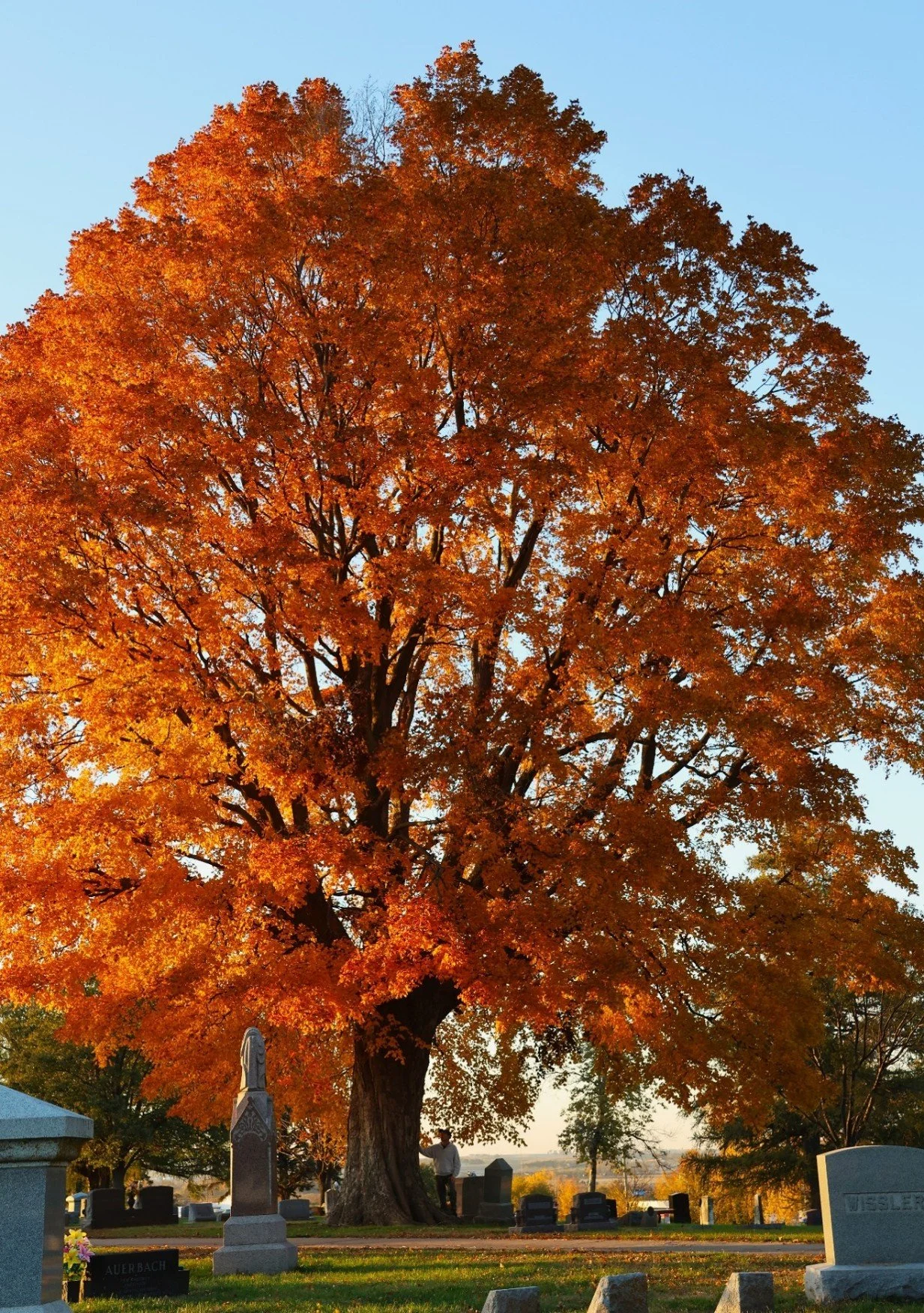
Circ. 13.67’, height 72.75’, spread 72’, index 254.75, rank # 1
I was hoping to get some good photos of this maple, but a frost had reduced the vibrancy of the color. Despite the reduced color, it was late in the day, and the early evening sun helped to enhanced the less than spectacular color.
November 12th
Today in Clinton, I met my friend Bob Vertz. We met at the site where Matt Markworth and I had measured three big bur oaks in April. I wanted to return to measure two big red maples. The larger of the two trees turned out to be a silver maple, which was disappointing, since for several months, I had been anticipating documenting a new champion red maple! The lone red maple may be a fusion, but I gave it the benefit of the doubt. Here are the dimensions of the red maple:
Circ.7.92’, height 82.83’, spread 41.835’, index 188.289, rank # 6
Our next stop was the site of the champion hemlock near Sabula. Here are the updated dimensions of the largest hemlock in Iowa:
Circ. 12.25’, height 85.67’, spread 50’, index 245, rank # 1
On the property where the champion hemlock grows, stands a tall arborvitae. I had noticed the tree before but I had never had time to get measurements. Here are the dimensions of the arborvitae:
Circ. 7.58’, height 71.67’, spread 23’, index 168.42’, rank # 18
The circumference and spread of the arborvitae above are nothing special, but the height beats the old Iowa height record by nearly five feet!
After a motel night in Clinton, we headed to Dubuque. After arriving in Dubuque, I soon noticed a good sized horse chestnut which I hope to follow up on sometime. I had permission to measure a white oak that Matt Markworth and I had spotted back on May 24th. Bob and I found the tree to have these dimensions:
Circ. 15.08’, height 72.17’, spread 100.5’, index 279.295, rank # 6
This tree was mentioned in the previous report. It is a magnificent tree, but some of the limbs have died. It doesn’t take long to see the problem. A retaining wall was put in not far from the tree which altered the grade by four or five feet!
Now it was time to go see the magnificent McGregor Walnut. We updated the circumference, and now it was time to measure the height. It is not easy to locate the highest twig on this tree, and I was feeling discouraged because it was getting dark, and I had not yet found the high point. When I finally located the highest twig it was really too late for measuring. It was so dark I was having trouble lining up the rangefinder with the tape measure at 4 ½’. I did the best I could, but I left wondering if the measurement was accurate. If you know me, this is something that would bother me until I could measure the height properly! Here are the dimensions of the walnut with only the circumference and height updated:
Circ. 10.5’, height 131.25’, spread 72’, index 275.25, rank # 9
November 17th
Laurie Dams picked me up, and we headed to an area west of Perry to measure a cottonwood. I wasn’t 100 percent certain it had a single trunk, but we didn’t think there was enough evidence to prove it wasn’t a single trunk, so we gave it the benefit of the doubt. This is what we found:
Circ. 24.71’, height 90.17’, spread 97.79’, index 411.118, rank # 5
November 20th
Laurie and I went to the Cemetery in Guthrie Center. First we checked on the champion blue spruce. Here are the updated dimensions of the spruce:
Circ. 9.79’, height 75.33’, spread 32.5’, index 200.955, rank # 1
At the east side of the cemetery stands a white fir which I would describe as the world’s largest bush. It has multiple leaders, and the lowest lateral branches are fairly close to the ground. Because of the density of branches, it would be impossible to keep the tape measure straight at’ 4 ½’, or anywhere else except much closer to the ground where there are no branches. We measured the circumference well below 4 ½’ and here is what we found:
Circ. 14.54’, height 60.58’, spread 57.625’, index 249.486, rank # 1
It is hard for me to get excited about this new champion. Even though it has the most points it doesn’t come close to having the most volume. I’m thinking of returning and attempting to get a measurement at 4 ½’, even though it would be exaggerated because of the twists and turns to get past the branches, it would likely be a truer gauge of the circumference than what we currently have. I may also be able to determine the trunk diameter which could be used to calculate the circumference.
November 22nd
Grady and I went on a trip to northeast Iowa, and on the way we stopped in Cedar Falls. For years, I have been wanting to measure a Douglas-firs just a few blocks northeast of the University of Northern Iowa. There are several Douglas-firs here on the parking right of way. Here are the dimensions of the largest one:
Circ. 8.42’, height 82.25’, spread 46.875’, index 194.968, rank # 5
The next stop was in western Waterloo where we measured two trees in close proximity that weren’t on the agenda. One was a blue spruce just east of Irv Warren Memorial Golf Course. The top several feet of the tree were dead and they have been for several years. The height measurement of the following dimensions includes the dead top:
Circ. 8.04’, height 86.83’, spread 35.415’, index 192.684, rank # 3
Just across the street, on the adjacent golf course grounds, was a ponderosa pine standing in the open. We found it to have these dimensions:
Circ. 8.17’, height 61.42’, spread 36.83’, index 168.948, rank # 13
Ten years ago, Steve Cooper and I measured a Douglas-fir on private property in Waterloo. It was good sized and healthy when it was first measured, and I was thinking, after ten years of growth it might have a chance to be among the biggest in Iowa. It took a while because the property had recently changed hands, but I finally had permission to measure the tree. Unfortunately, the tree had been hit by lightning, probably not long after it was first measured ten years ago. Although the Douglas-fir was alive, it was clearly struggling, and additional growth was minimal. Here are the dimensions of the Douglas-fir:
Circ. 8.71’, height 83’, spread 48.5’, index 194.625, rank # 6
Our next stop was Linwood Cemetery in Dubuque. Here are the dimensions of one of my favorite sycamores with only the circumference updated. The height and spread dimensions are from 2021.
Circ. 15.04’, height 119.67’, spread 110.79’, index 327.408, rank # 14
We inspected the co-champion European larch, which grows on a steep slope, and the trunk flairs out quite a bit, so getting an accurate circumference can be tricky. The dimension we found was actually less than the previous measurement, which means we must have measured the circumference at a point a little higher up this time.
November 23rd
After spending the night in Guttenberg, we headed to McGregor to visit the tallest Iowa deciduous tree, the McGregor Walnut. My goal was to see if the height measurement from my previous visit was accurate, and to get higher resolution photos. I was glad to determine the height had not been overstated. In fact, we were able to add a few inches. Here are the dimensions we found for the walnut:
Circ. 10.5’, height 131.58’, spread 85.418’, index 279.015, rank # 6
The largest known Iowa hophornbeam lives west of Pikes Peak State Park. We updated the dimensions of this tree, and this is what we found:
Circ. 6.92’, height 40.75’, spread 46.5’, index 135.125, rank # 1
The owner showed us a large bitternut hickory on his property, but we were already well past the time we should have left, so we would have to measure it another time.
December 20th
I teamed up with Scott Carlson, and Bob Vertz to measure some trees in Davenport. Our first stop was at the site of a tulip tree in an old neighborhood of east Davenport, just a short distance from the Mississippi River. The tree and the adjacent large brick house were located on a hill overlooking the river valley to the south. I knew this was not going to be among the largest tulip trees, but it was worthy of documenting. We found it to have the following dimensions:
Circ. 13.71’, height 100.5’, spread 77.418’, index 284.354, rank # 17
Our next tree was the champion white oak in east Davenport. Here are the updated dimensions:
Circ. 18’, height 71’, spread 111.5’, index 314.875, rank # 1
Despite losing a large limb a few years earlier, the average crown spread increased about seven feet since it was first measured in 2007.
Our next stop was to measure a pin oak I had admired for years, but I had never been granted permission to measure. Persistence finally paid off because a new owner turned out to be very cooperative. Here are the dimensions of this exemplary pin oak:
Circ. 16.46’, height 92.25’, spread 91.25’, index 312.563, rank # 2
Not far from the previous pin oak stands another exceptional specimen which I first measured in 2019. We found it to have these dimensions:
Circ. 15.42’, height 89.58’, spread 103.54’, index, 300.465, rank # 6
Not too far from the aforementioned pin oaks stands a respectable baldcypress. We determined the tree to have the following dimensions:
Circ. 12.17’, height 79.58’, spread 51.335’, index 238.414, rank # 5
After measuring the baldcypress Bob headed home leaving just Scott and I to measure one more trees.
On the near west side of Davenport there is a walnut that is primarily noteworthy because of the crown spread. It took quite a bit of time and effort to garner permission to measure this one. We found it to have the following dimensions:
Circ. 11.17’, height 77.17’, spread 102.25’, index 235.733, rank # 4
Now it was time to head to Scott’s place where I would spend the night.
December 21st
Scott joined me again, and our first stop was Pine Hill Cemetery in northeast Davenport. There are a couple of significant trees in this cemetery, including a quality tulip tree located in the eastern part of the cemetery. Here are the updated dimensions of the tulip tree:
Circ. 17.33’, height 100.17’, spread 79.023’, index 327.926, rank # 2
The other notable tree in Pine Hill Cemetery is a white mulberry. Here are the updated dimensions:
Circ. 15.83’, height 61’, spread 70.85’, index 268.723, rank # 2
Our next stop was to update the dimensions of Iowa’s only national champion tree, a European alder, in Duck Creek Park. We determined the tree to have the following dimensions:
Circ. 9.54’, height 98.17’, spread 30.656’, index 220.334, rank # 1, National Champion
Although the height and circumference has increased the spread has actually lost ten feet since it was first measured in 1987!
There are dozens of European alders in the wooded section of Duck Creek Park. Because they grew in the timber none of them have large trunks, but some of them are quite tall. While we were looking for other big alders we found one that was taller than any others in the park, and it turned out to be a new height record for Iowa! Here are the dimensions of the tallest European alder in Iowa:
Circ. 8.33’, height 107.08’, new height record, spread 38.665’ index 216.746
This recently found European alder is actually large enough to qualify as a national co-champion!
Our next stop was the enormous wahoo in Bettendorf. Over the years there had been discussions among some of us as to whether this was a native wahoo. With a circumference of 7.42’ it would seem to be too large for our native wahoo, but the seeds matched perfectly. The tree did have some dead branches, and it had been pruned back from the power lines, but thank goodness it was still alive.
Now it was time to update the dimensions of the other state co-champion white mulberry, located on private property in east Davenport. Of the following dimensions, only the circumference was updated:
Circ. 15.92’, height 58’, spread 78.75’, index 269.188, rank # 1
It was getting late in the day but, surely we could measure one more tree! We decided to update the circumference of the largest red oak in Davenport. Of the following dimensions, only the circumference was updated:
Circ. 18.67’, height 81.33’, spread 85’, index 326.58, rank # 1
The tree was last measured in October of 2019, and at that time the circumference was 17.5’. Perhaps the 2019 circumference was measured a little higher up on the trunk because an increase of 14” in six growing seasons would be an incredible growth rate! It was only five o’clock, but it gets so dark by that time in late December that we reluctantly had to call it a day. Scott and Leah were kind enough to let me stay at their place for the night.
December 22nd
Scott was busy, so today I would be on my own. I went to Oakdale Memorial Gardens, on the east side of Davenport where I have been measuring several impressive tulip trees since 2008. There were five impressive tulip trees here, but the largest one came down a few years ago. The first tulip tree to be updated stands on the east side of the pond on the west side of the cemetery. I found the tree to have these dimensions:
Circ. 15.42’, height 105.42’, spread 83.436’, index 311.279, rank # 5
Further east on high ground stands a tulip tree that I consider to be the most impressive of all the Oakdale tulip trees. The updated dimensions are as follows:
Circ. 15.92’, height 105.17’, spread 79.333’, index 316.003 # 4
The next tulip tree for updating stands towards the eastern edge of the cemetery. This one is the tallest known tulip tree in Iowa. Here are the dimensions:
Circ. 14’, height 114.58’, spread 89.835’, index 305.038, rank # 11
Close to the previous tulip tree stands another one with an impressive height. I determined it to have these dimensions:
Circ. 12.17’, height 112.75’, spread 61.878’, index 272.219, rank # 19
Oakdale Memorial Gardens is not limited to just exceptional tulip trees; it also has two notable hemlocks. Here are updated dimensions for the larger of the two:
Circ. 11.08’, height 75.42’, spread 55.5’, index 222.295, rank # 3
Here are the dimensions of a hemlock that had never been measured until now:
Circ.9.75’, height 78.92’, spread 49.335’, rank # 8
From Oakdale, I headed to Duck Creek Park to update the circumference and height of sweetgum. Here are the updated dimensions:
Circ. 8.21’, height 74.25’, spread 43.5’, index 183.625, rank # 11
Before heading home, I did some looking around Davenport where I found a large Kentucky coffeetree, but unfortunately it was a fusion. Then I located and inspected a very large hybrid elm. It may be a fusion, but it looked better than most. I also saw an impressive ponderosa pine, which I hoped to measure, but no one was at home. This would be the last tree measuring day of 2025. Below are some photos of trees described in this report.
August 6th 2025
Sugar maple, Gladbrook
Circ. 16.5’, height 77.58’, spread 96.58’, index 299.725, rank # 1
August 6th 2025
Sugar maple, Gladbrook
Circ. 16.5’, height 77.58’. spread 96.58’, index 299.725
August 14th, 2025
American elm, Sigourney
Circ. 18.04’, height 70.92’, spread 126.915’, (max. spread 136.33’)
It doesn’t appear to be DED, but what is causing the sparse foliage and the dead branch?
August 21st, 2025
Cucumbertree, North English
Circ. 15.21’, height 64.92’, spread 76.75’, index 266.08, rank # 1
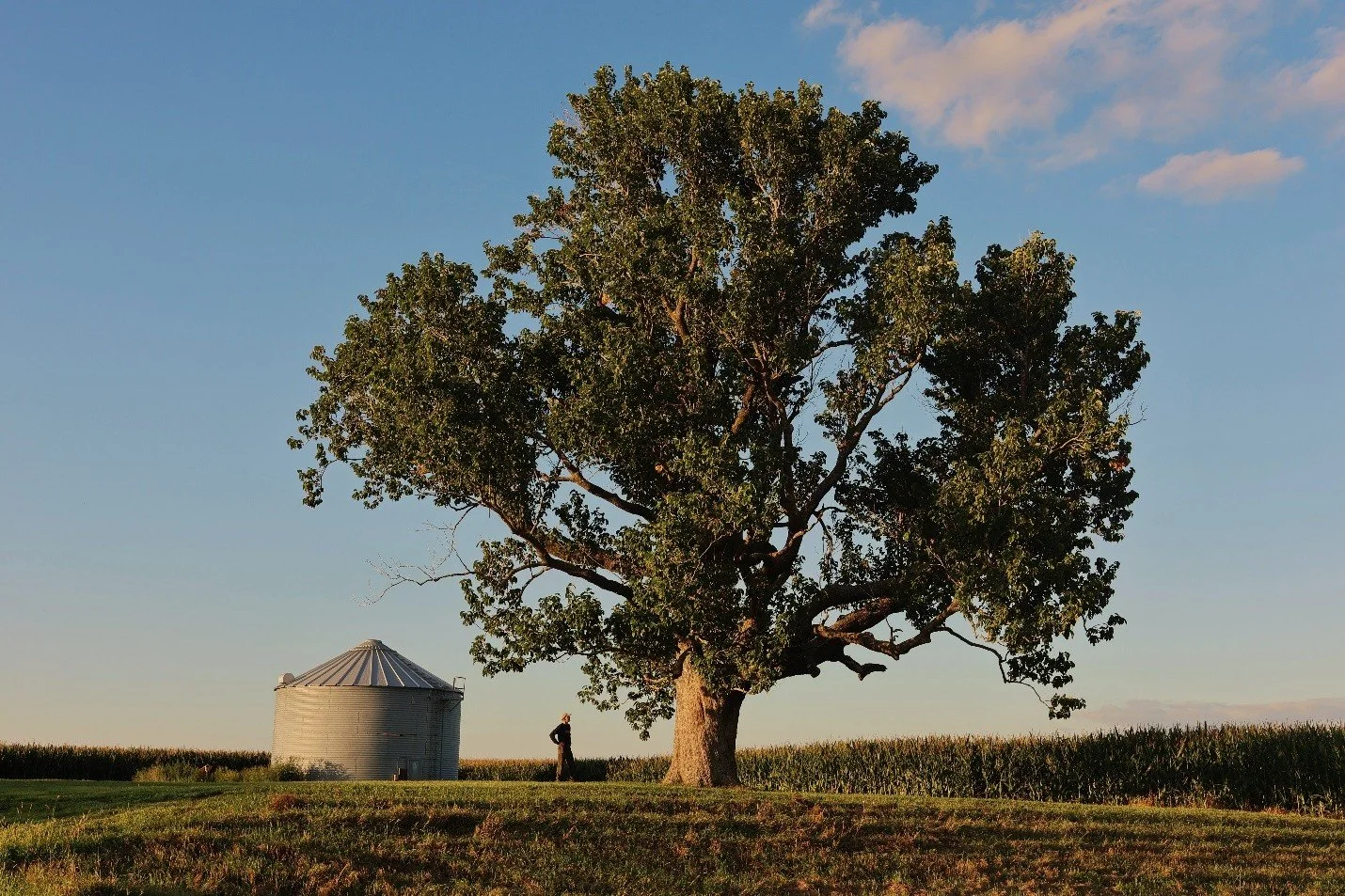
August 23rd 2025
Cucumbertree, North English
Circ. 15.21’, height 64.92’, spread 76.75’, index 266.08, rank # 1
August 24th, 2025
Cottonwood in the middle of the road near Brayton
Circ.- 21.71’, height 67.17, spread 72.835, index 345.879, rank # 34
August 24th, 2025
Cottonwood in the middle of the road
Circ.- 21.71’, height 67.17’, spread 72.835’, index 345.879, rank # 34
October 4th 2025
White fir, Hampton
Circ. 11.125’, height 96.25’, spread 36.75’, index 237.563, rank # 3
October 30th 2025
Mugo pine, Sioux City
Circ. 8.5’ @2’, height 33.33’, spread 45.42’, index 146.684
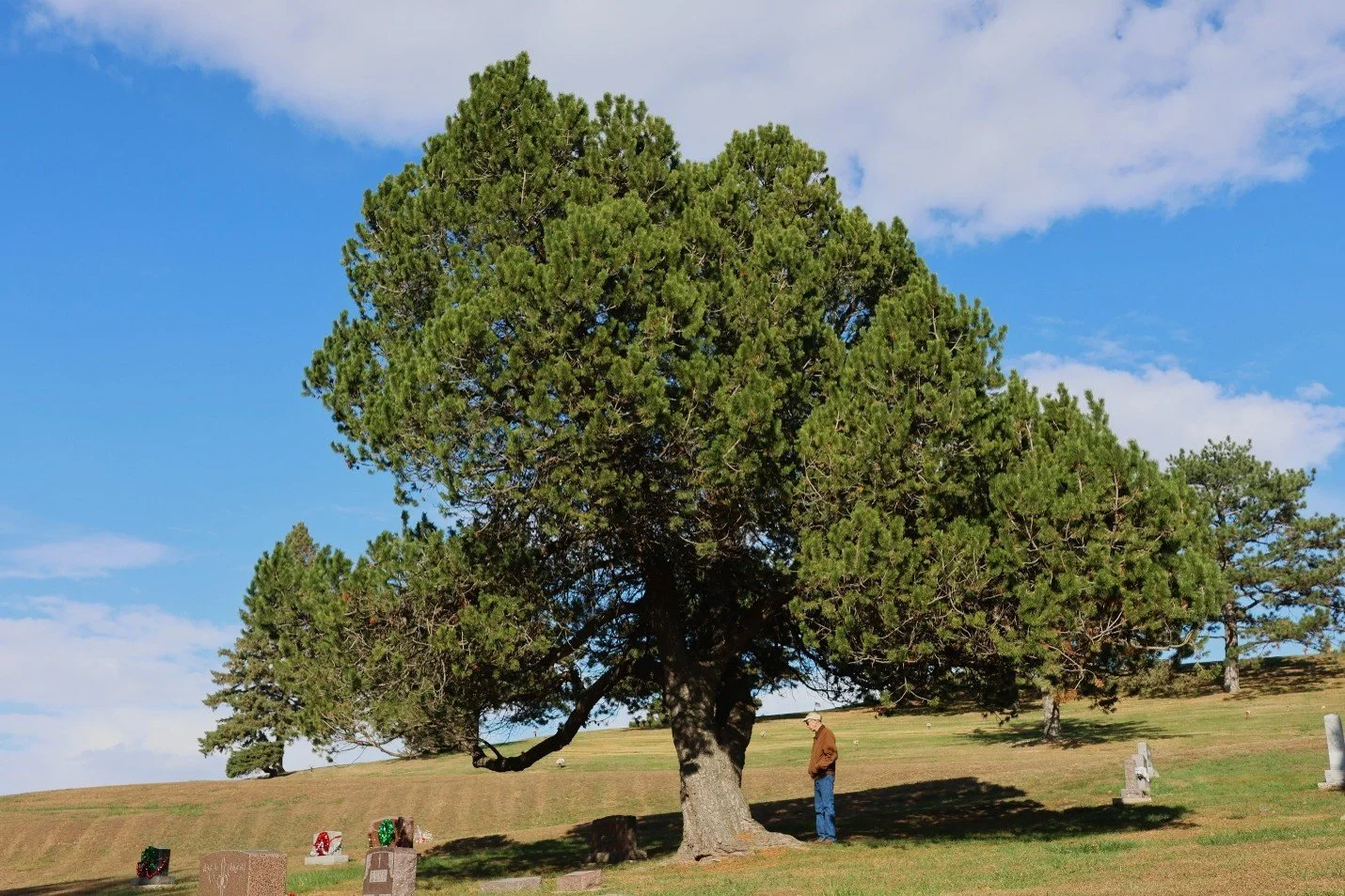
November 11th, 2025
black maple, Atlantic
Circ. 13.67’, height 72.75’, spread 72’, index 254.75, rank # 1